

How do you start feeding your baby at 6 months? You’ve probably already been to your pediatrician and they’ve explained it in detail. They may even have given you a pile of papers with instructions.
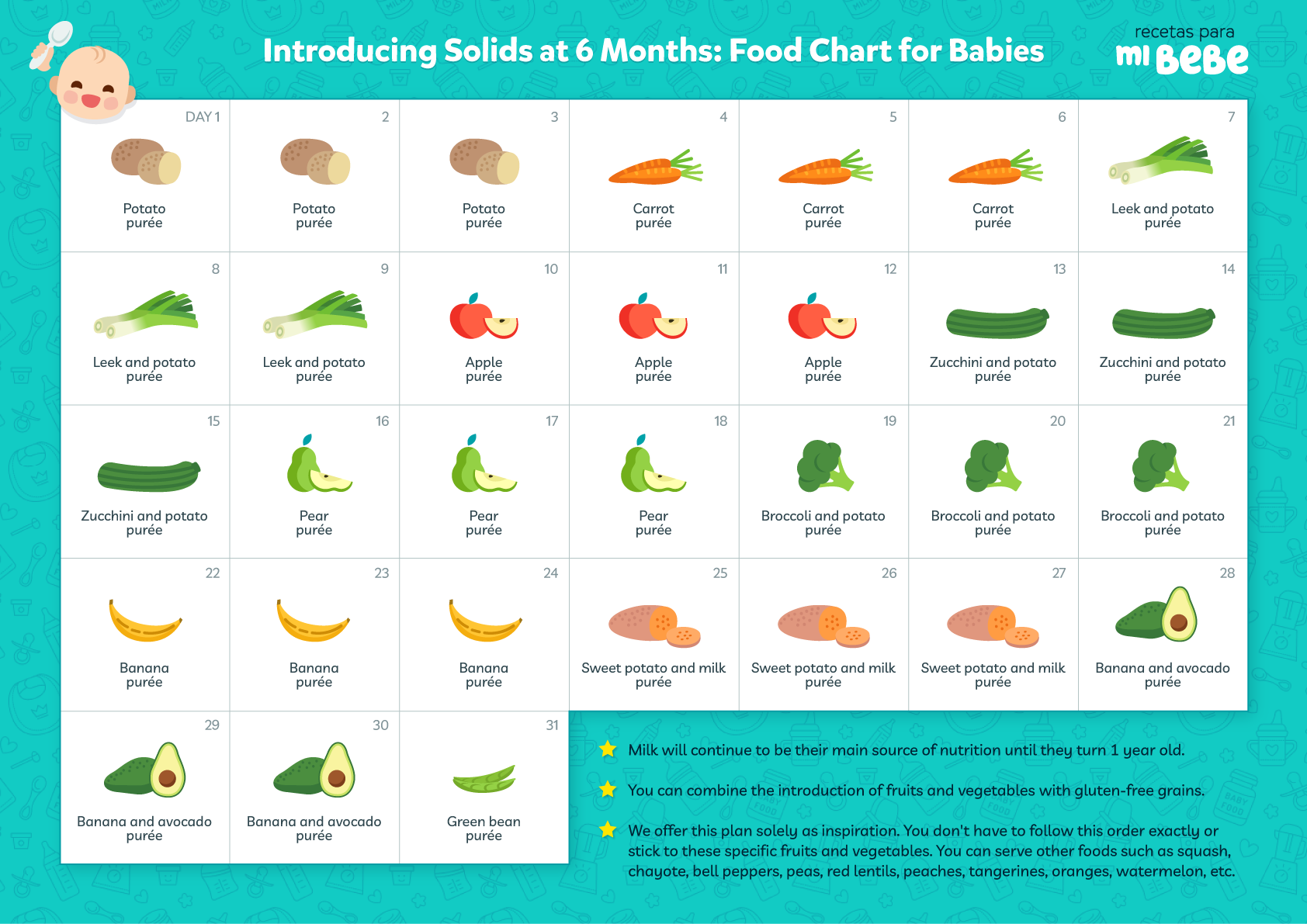
Even so, moms and dads often have lots of doubts and questions about how exactly to get started. That’s why we want to offer you a visual guide, just as a reference, showing how you could introduce your baby’s first foods.
- What order to introduce foods in
- When can I start introducing solids?
- What can a 6-month-old baby eat?
- How much should a 6-month-old baby eat?
What order to introduce foods in
Pediatricians usually recommend starting with cereals, fruits or vegetables, waiting 2 to 3 days before offering a new food to spot possible allergies.
We suggest this chart only as inspiration. You don’t have to follow this exact order or use these particular fruits and vegetables. You can offer other foods such as pumpkin, chayote, bell pepper, peas, red lentils, peach, mandarin, orange, watermelon, etc.

When can I start introducing solids?
Complementary feeding usually begins between 5 and 6 months (and never before 4 months), as your pediatrician advises. Remember that the WHO (World Health Organization) and UNICEF recommend exclusive breastfeeding until 6 months.
It’s important to talk to your pediatrician or doctor. Every baby is unique, and only a professional can assess whether your baby is ready to take this step. If your baby can hold their head up, sit upright with support and shows interest in putting objects in their mouth, they’re likely ready to try other foods besides milk.
This new stage is very important because, by offering your baby new flavors, textures and smells, you lay the foundation for their relationship with food.
What can a 6-month-old baby eat?
Milk (breast milk or formula), cereals, vegetables and fruits.
The WHO says that fruits, cereals or vegetables can be introduced in any order. And the American Academy of Pediatrics advises “Your baby’s first foods are your choice.“
Simply offer your baby new foods one at a time, leaving several days between them so you can spot allergies. And don’t forget that milk, breast milk or formula, will remain their main source of nutrition until they turn one.
We should avoid honey, chard and spinach because of their nitrite content, herbal teas, large fish that may contain mercury and cow’s milk dairy products. And of course, no sugar or salt.

How much should a 6-month-old baby eat?
Until 6 months, breast milk or formula meets all of your baby’s nutritional needs. That’s why, when starting complementary feeding, you offer very small amounts, the equivalent of 2 or 3 teaspoons of purée. We just want them to taste it.
As the months go by, you can gradually increase the amounts until they eat the equivalent of a small jar of baby food (about 3/4 cup). If you have any doubts, check out our guide on how much a baby should eat by age.
More information
- Recommendations on complementary feeding for healthy, full-term infants Ital J Pediatr. 2015 Apr 28
- Habeat Project Booklet for parents
- When Can Babies Start Solid Foods? Readiness & Feeding Tips · American Academy of Pediatrics
- Guiding principles for complementary feeding of the breastfed child · WHO


